How to Get Your Vermont Hunting License
Vermont requires hunter education for anyone buying a hunting license for the first time, unless that person can show proof of having held a hunting, combination, archery, or trapping license from any state or province before. Hunter-Ed is a delegated provider for Vermont's hunter safety course, and the certificate itself never expires once you've earned it.
Once you're certified, if required, you'll need a hunting license, which costs $28 for residents and $102 for non-residents, plus any species-specific permits for the game you're after. You can purchase a license through the Vermont Fish and Wildlife Department website or an approved license agent, and licenses run on a calendar year, expiring every December 31.
Keep reading to learn how to get your Vermont hunting license and hunter education certificate, step by step.

What Is a Hunting License in Vermont?
A Vermont hunting license is the base document Fish and Wildlife requires before you can legally pursue game in the state. It's separate from the archery, muzzleloader, and turkey licenses you'll need for those seasons, which are purchased individually once you hold a valid hunting license.
Your hunter education certificate works differently. It's a one-time credential proving you completed an approved safety course, and it lasts for life, while your hunting license has to be renewed every calendar year.
Who Needs a Hunting License in Vermont?
Vermont requires a hunting license for anyone who hunts in the state, and hunter education adds an extra requirement tied to your licensing history and age rather than a birth-year cutoff. Whether you're under 18 and whether you've held a license before determine which path applies to you.
Hunter education runs on a separate track from the license itself. Anyone buying a hunting license for the first time must complete an approved course, unless they qualify for one of Vermont's exceptions instead:
- Under 18: Must complete the online Homework Course, then attend the required Homework In-Person Component to hunt independently.
- 18 and older, Vermont resident, never held a license: May complete the Traditional Course instead, which certifies immediately online with no in-person requirement.
- Any age, previously held a hunting, combination, archery, or trapping license from any state or province: Exempt from the hunter education requirement.
- Not ready for the course yet: May purchase the $10 Mentored Hunting License instead, hunting under the direct supervision of a fully licensed adult.
How to Get Your Vermont Hunting License (Step-by-Step)
Getting licensed in Vermont comes down to a few main steps, though the order shifts slightly depending on your age and licensing history. Here's the full process from start to finish.
- Complete an approved hunter education course if you've never held a license, then attend the required in-person component if you're under 18 or took the Homework Course.
- Choose your license type: Hunting, Combination, Youth, or Mentored Hunting License.
- Purchase your license through the Vermont Fish and Wildlife website, by mail, or at an approved license agent.
- Add any species-specific licenses you need, such as archery, muzzleloader, or turkey.
- Carry your license, permits, and certificate any time you hunt.
Vermont's moose and antlerless deer permits are drawn by lottery, so plan ahead if either is on your list. Once your license and any needed permits are in hand, you're ready for the field.
The sections below cover the hunter education course and license purchase in more detail.

Step 1: Complete an Approved Hunter Education Course
Vermont's certification path splits by age and residency rather than by format alone.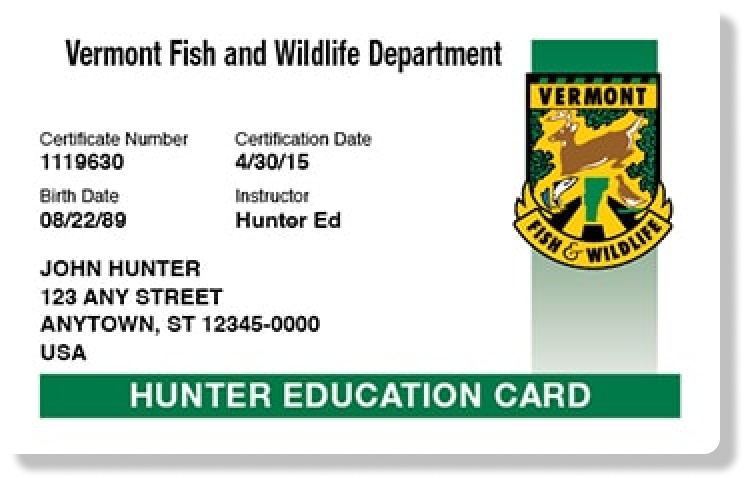
- Traditional Course (18 and older, Vermont residents only): Complete the Hunter-Ed Vermont course at no cost and pass the final exam to print your certificate immediately, with no in-person requirement.
- Homework Course plus in-person component (under 18, or any age, open to residents and non-residents): Complete the same free online course, then register separately for the required in-person Homework In-Person Component to receive your certificate.
- Mentored Hunting License: Skip certification temporarily for $10 by hunting under the direct supervision of a fully licensed adult mentor instead.
Passing the online course doesn't guarantee an in-person seat, so register for both well ahead of the season you're planning to hunt.
Step 2: Buy Your Hunting License
Once you have your hunter education certificate or a qualifying exemption, if it applies to you, you can buy your license through the Vermont Fish and Wildlife website, by mail, or at an approved license agent.
You'll need proof of hunter education or a prior license, proof of Vermont residency if applying for resident rates, and payment.
Step 3: Add Species Licenses and Go Hunting
A standard Vermont hunting license doesn't cover archery deer, muzzleloader deer, turkey, or early bear season. Each of those require their own license, purchased separately, and antlerless deer and moose permits are drawn by lottery.
Once your license and any needed permits are in hand, you're ready to hunt.
Vermont Hunting License Requirements by Age
Here's a high-level overview of the requirements for hunting licenses in Vermont by age.
Vermont Hunting License Requirements (by Age) | ||
| Age | Requirement | Supervision/Hunter Education |
| 17 and younger, resident | Youth Hunting License ($8) or Youth Combination License ($12) | Certification required unless a prior license was held |
| 17 and younger, non-resident | Youth Hunting License ($25) or Youth Combination License ($30) | Certification required unless a prior license was held |
| 18 and older, resident | Hunting License ($28) or Combination License ($47) | Certification required unless a prior license was held |
| 18 and older, non-resident | Hunting License ($102) or Combination License ($143) | Certification required unless a prior license was held |
| 66 and older, resident | Permanent License, one-time fee ($60) | Certification not required if a prior license was held |
| Any age, not yet certified | Mentored Hunting License ($10, resident or non-resident) | Must hunt under the direct supervision of a fully licensed adult mentor |
| Non-resident active-duty military stationed in Vermont | Resident-rate license | Certification required unless a prior license was held |
Privileges and stamps:
- Archery deer ($23 resident, $38 non-resident), muzzleloader deer ($23 resident, $40 non-resident), turkey ($23 resident, $38 non-resident), and early bear season ($5 resident, $15 non-resident) each require a separate license beyond the base hunting license.
- Waterfowl hunters 16 and older need a Vermont Waterfowl Stamp ($7.50) and a Federal Duck Stamp, along with HIP registration.
- Non-residents who only want to bowhunt deer can skip the base license entirely with the $75 Archery Only-Deer license.
Season dates and bag limits vary by species and weapon type, so check before you plan a hunt.
Hunter Safety Course: Format and Cost
Vermont stands out for offering its hunter education course entirely free of charge, whichever path applies to you. The chart below offers a quick overview of those formats.
Vermont Hunter Safety Course Formats Comparison | ||||
| Format | Provider | Cost | Time | Exam |
| Traditional Course Online (18 and older, residents only) | Hunter-Ed | Free | Self-paced, a few hours online | Unit quizzes and final exam, 80% passing score. Certificate prints immediately. |
Homework Course plus in-person component (under 18, or any age, residents and non-residents) | Hunter-Ed | Free | Self-paced online, plus an in-person session | Same online exams, plus a hands-on exam at the Homework In-Person Component |
No matter the format you choose, your hunter education certificate is permanent once issued. Only your hunting license needs renewing, and since Vermont runs on a calendar year, that happens every December 31.
Documents Required To Buy Your License
Make sure you have the right documentation handy to purchase your Vermont hunting license. You'll need:
- A valid form of identification
- Proof of hunter education certification, or proof of a hunting, combination, archery, or trapping license held previously in any state or province
- Payment for your license and any species-specific licenses
- Proof of Vermont residency, if applying for resident rates
Vermont Hunting Laws and Penalties
Vermont uses a uniform point system rather than a flat fine schedule for most violations: accumulating 10 to 14 points within five years triggers a one-year license suspension, 15 to 19 points triggers two years, and 20 or more points triggers three years.
Big game and threatened-species violations carry their own fines up to $2,000 for a first conviction, escalating for repeat offenses, along with possible imprisonment, license revocation, and forfeiture of equipment used in the violation.
Vermont participates in the Interstate Wildlife Violator Compact, so a suspension here can follow you into other member states, and even landowners can't hunt their own land while suspended. You can read more on Vermont's hunting laws and regulations before you head out.
What About Reciprocity with Other States?
Vermont accepts hunter education certificates from any U.S. state, Canadian province, or country that meets International Hunter Education Association (IHEA-USA) standards, and it works both ways. Your card travels with you if you hunt elsewhere.
What Out-of-State Visitors Should Know
Non-resident hunters pay $102 for an annual Hunting License, well above the $28 resident rate, though the $75 Archery Only-Deer license lets bowhunters skip the base license entirely.
Hunters who've never held a license must still meet Vermont's hunter education requirement regardless of home state, and since the Traditional Course is limited to Vermont residents, non-residents complete their first certification through the Homework Course and its in-person component instead.
Start Your Vermont Hunter Safety Course Today, Then Get Your Hunting License
The Hunter-Ed Vermont course is approved by Vermont Fish and Wildlife, free, and available on any device. Vermont residents 18 and older can complete it with no in-person requirement, while everyone else also needs to attend and pass the in-person Homework In-Person Component.
Complete the course and get your lifetime Vermont hunter education certificate.

Approved by Vermont Fish and Wildlife Department | Last verified August 13, 2026
Frequently Asked Questions (FAQs)
Q: Do I need a hunting license to hunt in Vermont?
A: Yes, anyone who hunts in Vermont needs a hunting license, with youth, adult, and permanent options depending on your age and residency. Species like archery deer, turkey, and early-season bear each require their own additional license.
Q: How much does a Vermont hunting license cost?
A: A Vermont resident annual hunting license costs $28, while a non-resident license costs $102. Youth licenses cost as little as $8, and a one-time Permanent License is available to residents 66 and older for $60.
Q: Who needs hunter education certification in Vermont?
A: Vermont requires hunter education certification for anyone buying a hunting license for the first time. Hunters who can show proof of a prior hunting, combination, archery, or trapping license from any state or province are exempt from the requirement.
Q: Can I take Vermont's hunter education course entirely online?
A: It depends on your age and residency. Vermont residents 18 and older can complete the Traditional Course fully online with no in-person requirement, while everyone else, including all hunters under 18, must also attend the Homework In-Person Component.
Q: Is there a way to hunt in Vermont before completing hunter education?
A: Yes, Vermont offers a $10 Mentored Hunting License for hunters who haven't yet completed hunter education. It requires the mentee to hunt under the direct supervision of a fully licensed adult mentor.
Q: Can non-residents take Vermont's Traditional hunter education course?
A: No, the Traditional Course is limited to Vermont residents 18 and older. Non-residents complete their first Vermont hunter education certification through the Homework Course, which includes a required in-person component.