Alaska has no general mandatory hunter education requirement, unlike most states.
Hunter education is only required for hunters born on or after January 1, 1986, who plan to hunt on certain federal lands, or for specific weapon-restricted hunts like archery, crossbow, or muzzleloader. The course itself isn't required to purchase a license for hunters outside those categories.
A resident annual hunting license costs $45, while a non-resident annual license costs $160. Licenses are sold through the Alaska Department of Fish and Game (ADF&G) online store or through an authorized vendor, and Alaska licenses expire on December 31 of the calendar year regardless of purchase date.
This guide walks you through how to get your Alaska hunting license and Hunter Education Certificate, step by step.
What Is a Hunting License in Alaska?
An Alaska hunting license is the base document ADF&G requires before you can hunt most species in the state. Big game species like moose, brown bear, and Dall sheep each require a separate locking tag purchased on top of the base license, and some hunts require a drawing permit rather than an over-the-counter purchase.
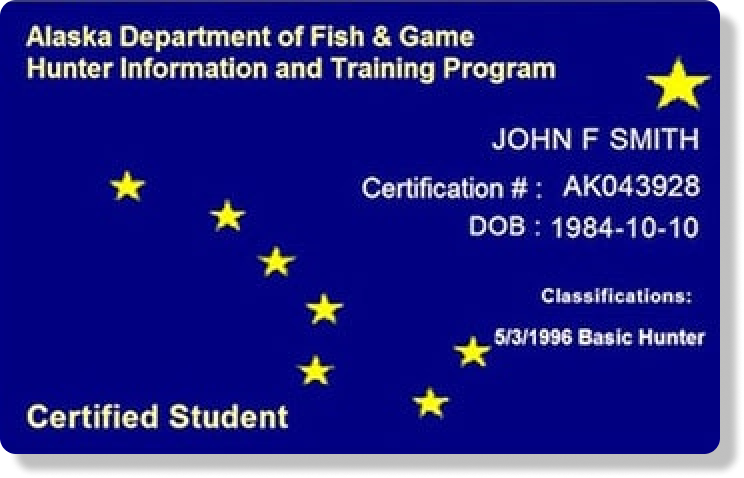
Your Hunter Education Certificate, when it applies to you, is a different document entirely. It proves you completed an ADF&G-approved safety course, and once you earn it, it never expires. Your license, on the other hand, is only good through December 31 of the year you bought it.
Who Needs a Hunting License in Alaska?
Alaska requires a hunting license for residents 18 and older and most non-residents who hunt in the state, with several built-in age exceptions that don't apply anywhere else in this series.
Hunter education in Alaska works differently than in most states. Hunters born on or after January 1, 1986 need certification only if hunting on certain federal lands or in weapon-restricted areas, not as a general statewide requirement:
Resident, age 17 and younger: No hunting license required at all, though certification or direct supervision by a licensed hunter is required if hunting on federal land where it applies.
Resident or non-resident, age 18 and older, hunting on affected federal land: Complete hunter education if born on or after January 1, 1986, since Alaska's requirement applies there regardless of residency.
Any hunter pursuing an archery-only, crossbow, or muzzleloader hunt: Complete the matching weapon-specific certification (bowhunter, crossbow, or muzzleloader education) if born on or after January 1, 1986, since general hunter education doesn't cover these.
60 and older (resident): Eligible for a free permanent identification card in place of an annual license, though permits and harvest cards are still required.
Whichever category applies to you, keep proof of your license and, if required, your certification on hand while hunting.
How to Get Your Alaska Hunting License (Step-by-Step)
Getting licensed in Alaska depends heavily on where and how you plan to hunt, since certification isn't a blanket requirement the way it is in most other states. Here's the full process from start to finish.
Purchase your license through the ADF&G website or an authorized vendor.
Select your license type: resident ($45), non-resident ($160), or non-resident alien ($630).
Add any big game locking tags, drawing permits, or stamps required for the species you're after.
Carry your digital or printed license, plus your Hunter Education Certificate if required, any time you hunt.
Once you've completed these steps, you're fully licensed and ready for the field. The sections below cover the hunter education course and license purchase in more detail.
Step 1: Complete an Approved Hunter Education Course
Alaska's course only applies to a subset of hunters, but the process itself is the same online-plus-Field-Day structure used elsewhere.
Online course plus Field Day: Complete the Hunter-Ed Alaska course ($19.95), wait three business days for your data to reach ADF&G, then register for the required in-person Field Day, which runs 4 to 5 hours.
Weapon-specific certification: If you're hunting big game with archery, crossbow, or muzzleloader equipment and were born on or after January 1, 1986, complete the matching weapon-specific course instead, since it's separate from general hunter education.
Either path requires a Field Day with a live shooting proficiency test, and once earned, your certification never expires.
Step 2: Purchase Your License
Once you have your Hunter Education Certificate, if it applies to you, you can buy your license through the ADF&G website or through an authorized vendor.
You'll need a government-issued photo ID, your Social Security number, proof of residency if applicable, and payment.
Step 3: Add Tags and Go Hunting
Your base Alaska hunting license doesn't cover big game on its own. Species like moose, brown bear, and Dall sheep each require a separate locking tag, and some hunts are limited to a drawing permit rather than an over-the-counter purchase.
Once your license and any needed tags or permits are in hand, you're ready to hunt.
Alaska Hunting License Requirements by Age
Here's a high-level overview of the requirements for hunting licenses in Alaska by age.
Alaska Hunting License Requirements (by Age)
Age
Requirement
Supervision/Hunter Education
Resident, 17 and younger
No license required
Hunter education or direct adult supervision required on affected federal land
Resident or non-resident, 18 and older
Resident ($45) or Non-Resident ($160)
Hunter education required only for affected federal land or weapon-restricted hunts, if born on or after Jan. 1, 1986
Non-resident alien, any age
Non-Resident Alien ($630)
Same hunter education rules apply as other non-residents
60 and older (resident)
Free permanent ID card
Replaces the annual license. Permits and harvest cards still required.
Privileges and stamps:
Big game hunters need a locking tag for species like moose, brown bear, and Dall sheep, with non-resident tags ranging from roughly $800 for moose to $1,000 for brown bear.
Waterfowl hunters need a state waterfowl stamp plus free HIP registration
Non-residents hunting brown or grizzly bear, Dall sheep, or mountain goat must hunt with a registered guide.
Alaska's course structure differs from most states because it applies only to hunters affected by federal land or weapon-specific rules, and the online option still ends with an in-person Field Day. The chart below offers a quick overview of the format.
Alaska Hunter Safety Course Formats Comparison
Format
Provider
Cost
Time
Exam
Online plus Field Day person session
Hunter-Ed
$19.95
Self-paced online, plus a 4- to 5-hour in-
Online quizzes, then a required Field Day with a live shooting proficiency test
Once you've earned it, that certification sticks with you for life, no renewal necessary. Only your Alaska hunting license needs replacing, and that happens every year when it expires on December 31.
What to Bring To Buy Your License
Make sure you have the right documentation handy to purchase your Alaska hunting license. You'll need:
A government-issued photo ID
Your Social Security number
Proof of your Hunter Education Certificate, if it applies to your hunt
Payment (card online or in person)
Proof of Alaska residency, if applying for resident rates
Alaska Hunting Laws and Penalties
Hunting without a valid license in Alaska is a misdemeanor punishable by a fine of up to $1,000 and up to six months in jail. Additionally, wanton waste of big game or wild fowl, including failing to salvage required cuts like the hindquarters down to the hock, is a Class A misdemeanor carrying a mandatory minimum of seven consecutive days in jail and a $2,500 fine that a judge cannot suspend or reduce.
More serious violations, including falsely claiming Alaska residency to get resident rates, are Class A misdemeanors with fines up to $25,000 and up to a year in jail.
Visiting hunters should also be aware that bringing illegally taken game home from Alaska can trigger federal Lacey Act violations, with penalties well beyond what state law alone imposes.
What About Reciprocity?
Alaska accepts hunter education certificates from any U.S. state, Canadian province, or country that meets International Hunter Education Association (IHEA-USA) standards. States and provinces with their own mandatory hunter education requirements return the favor and accept an Alaska Hunter Education Certificate, so your card travels with you if you hunt elsewhere.
What Out-of-State Visitors Should Know
Non-resident hunters pay $160 for an annual license, or $630 for non-resident aliens, plus locking tags for any big game species pursued.
Note: Non-residents hunting brown or grizzly bear, Dall sheep, or mountain goat must hunt with a registered guide.
Those born on or after January 1, 1986 face the same limited hunter education requirements as residents for affected federal land and weapon-restricted hunts.
Start Your Alaska Hunter Safety Course Today, Then Get Your Hunting License
The Hunter-Ed Alaska course is approved by the ADF&G, self-paced, and available on any device, with an in-person Field Day required to complete certification. Complete the course and get your lifetime Alaska hunter education certificate.
Approved by Alaska Department of Fish and Game (ADFG) | Last verified August 12, 2026
Frequently Asked Questions (FAQs)
Q: How much does a hunting license cost in Alaska?
A: A resident annual hunting license in Alaska costs $45, while a non-resident annual license costs $160, both expiring every December 31. Big game hunters also need a locking tag for species like moose or brown bear, which can run non-residents anywhere from about $800 to $1,000 per species.
Q: Do I need hunter education to hunt in Alaska?
A: Alaska doesn't have a general hunter education requirement, unlike most states. Hunters born on or after January 1, 1986, only need certification if hunting on certain federal lands or pursuing a weapon-restricted hunt, such as archery, crossbow, or muzzleloader.
Q: Is a field day required for the online hunter safety course in Alaska?
A: Yes, Alaska's online hunter safety course requires an in-person Field Day after the online portion, typically running 4 to 5 hours. The Field Day includes a firearms handling exercise and a required live shooting proficiency test using equipment ADF&G provides.
Q: Can a 16-year-old hunt in Alaska without a license?
A: A 16-year-old Alaska resident can hunt without a license, since residents 17 and younger aren't required to have one. They still need hunter education or direct supervision by a licensed adult hunter if hunting on federal land where certification applies.
Q: Does Alaska's hunter education certificate work in other states?
A: Yes, an Alaska Hunter Education Certificate is accepted in any U.S. state, Canadian province, or country with a mandatory hunter education requirement that meets IHEA-USA standards. This reciprocity means Alaska-certified hunters generally don't need to retake a course before hunting elsewhere.
Q: What's the penalty for hunting without a license in Alaska?
A: Hunting without a valid license in Alaska is a misdemeanor punishable by a fine of up to $1,000 and up to six months in jail. Separately, wanton waste of big game, such as failing to salvage required meat, carries a mandatory minimum seven-day jail sentence and a $2,500 fine that cannot be reduced or suspended.