Snares
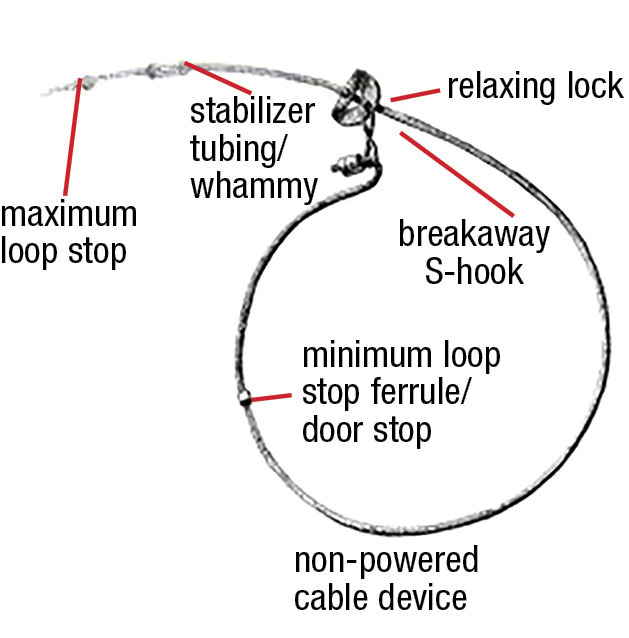
A snare is a device used to capture or restrain an animal by means of a loop around the head, neck, or body. This loop tightens when the animal pulls against it. Snares are effective on land and in the water when the height and loop size are set for a specific target species. In Ohio, only non-powered, non-lethal snares are legal.
- Here are the components of a snare.
- Cable: Snares in Ohio are required to be made from multi-strand steel cable. This cable is a network of smaller cables wrapped together for strength and flexibility. Common cable configurations are a 1x19 (1 bundle of 19 wires) or a 7x7 (7 bundles of 7 wires per bundle). In addition to the configuration of the cable, cables come in different sizes. Common sizes are 5/64" cable or 3/32" cable.
- Lock: A snare lock is a device that allows the loop to close and prevents the loop from opening back up. In Ohio, snares are required to have a relaxing lock. This type of lock stops tightening the snare loop when the captured animal stops pulling against the snare, making the snare non-lethal.
- To comply with Ohio regulations, one or both of the following two parts must be included on a snare.
- Deer Stop: A deer stop is a loop stop on the cable that prevents the snare loop from closing to a diameter of less than 2½". This device allows a deer’s foot to slide out of the loop and does not hold a deer by the hoof. Deer stops can be crimped or hammered onto the cable.
- Breakaway Device (or Relaxing Lock System): This device breaks away and releases the loop at no greater than 350 pounds. Types of breakaway devices include break-away J-hooks or S-hooks, or locks that will tear apart at or under 350 pounds of pressure. Breakaway devices are required to prevent the snaring of deer, livestock, or other non-target species.
- Swivel: A swivel lessens the chance of a captured animal twisting the cable and possibly breaking it. Most swivels are used in conjunction with a washer.
- Staking System: In Ohio, a snare must be secured to an immovable object or securely staked to the ground. A drag cannot be used with a snare. This is to prevent an animal from getting into an entanglement situation. Any type of entanglement may cause the snare’s cable to break or, more importantly, may turn the snare into a lethal device. Pressure from getting tangled in brush, in fences, over tree limbs, or down embankments causes the snare to cut off the blood flow and/or airway to the captured animal, resulting in the death of the animal.
- Snare Support: Also called a “whammy,” a snare support is an additional piece on the snare used to attach a snare support wire alongside the cable. Common snare supports are made from small wire twisted to the size of the wire being used or plastic tubing the support wire can slide into and hold fast.
- Stop: Aluminum stops are used on each end of the cable to attach a swivel, lock, or stake in place.
- Ferrule: Aluminum double ferrules are used to make a loop on the end of the cable. If the ferrule is hammered or crimped shut, the loop size stays the same. If the ferrule is used in conjunction with a stop to make a loop, the loop is adjustable.
- Snare Support Wire: Support wires are used to hold and position a snare on the trail. Common sizes for snare support wires are 9-gauge or 11-gauge.
- Cable Cutters: Although cutters are not part of the snare, trappers need a pair of cable cutters to cut the multi-strand steel cable. Cable cutters are often required to cut the cable off a snared animal. Be aware that a regular pair of wire cutters or pliers will not cut the multi-strand cable.
- Ohio has additional regulations for snares.
- The use of snares is limited in all public hunting areas (wildlife areas) unless a permit is issued by the Chief of the Division of Wildlife. Common permits include beaver and river otter snaring. For beaver/otter snaring on public land, a minimum loop diameter of at least 10" must be used, and the bottom of the snare must be covered with at least 1" of water at all times.
- No snare may be set with a loop larger than 15" in diameter.
- There cannot be any type of spring-loaded or mechanical devices on the snare to assist the snare loop in closing.
- As mentioned before, the height and loop size determine what animal is targeted when setting a snare. The following guide can be referenced for your target species.
- Snaring can be referred to as a “blind set” when no lure or bait is used. An example is a raccoon snare placed in the middle of a trail at 3" to 4" off the ground with a 6" to 8" loop size. While walking down the trail, a raccoon encounters all kinds of sticks, brush, or vines. It goes into the snare loop with its head and pushes its way through the snare loop. The lock allows the loop to close around the neck or body of the animal and hold the raccoon in place.
