Raccoon Sets
When making raccoon sets, keep in mind these animals are big and strong.
- Recommended types of traps are coil-spring foothold, longspring foothold, foot-encapsulating, cage, and bodygripping. With foothold traps, use good #1½ traps.
- Raccoons are strong enough to pull out of a solidly staked set. Use a drag instead. As the drag gives, the animal cannot get a solid pull. Along a stream, a 2" sapling about 6 feet long makes an ideal drag. In open areas, a two-pronged grapple can be used.
Many raccoons are caught in sets made for muskrats or mink, especially blind sets. In addition, the following sets may be used.
Cubby Set
Raccoons can be trapped at baited cubby sets.
- Make a cubby out of rocks, logs, or old boards. A natural cubby (for example, a hollow tree) also may be used.
- Place bait or lure at the back of the cubby.
- Place a foothold, bodygripping, or cage trap just inside the cubby opening.
This set can be used on land or in water.
- On land, the set will catch skunk and opossum, as well as raccoon.
- Near water, the set can be used for mink or muskrats. Build the cubby on a sloping bank where you find tracks. Use a sliding wire or tangle stake to make a drowning system.
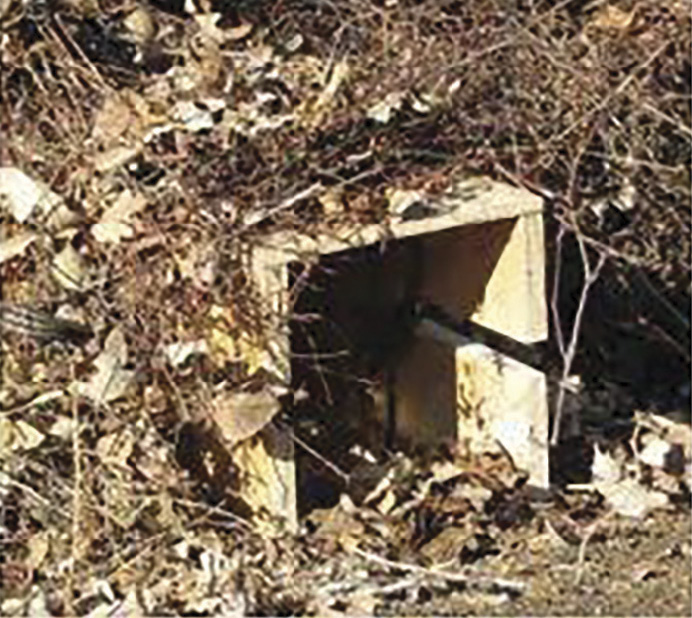
Cubby set
Overhanging Bank Set
When seeking raccoons, it is important not to set traps where dogs may be running. An overhanging bank with a clearance too low for dogs is an excellent location for a raccoon set.
- Fish or a sweet bait could be placed along the bank, under the overhang.
- The trap should be placed in the water beneath the bait. Wire the trap chain to a rock in deep water.
Drain Tile Set
Raccoons frequent drain tile openings and drainage ditches. A drain tile is a good place for a trap set.