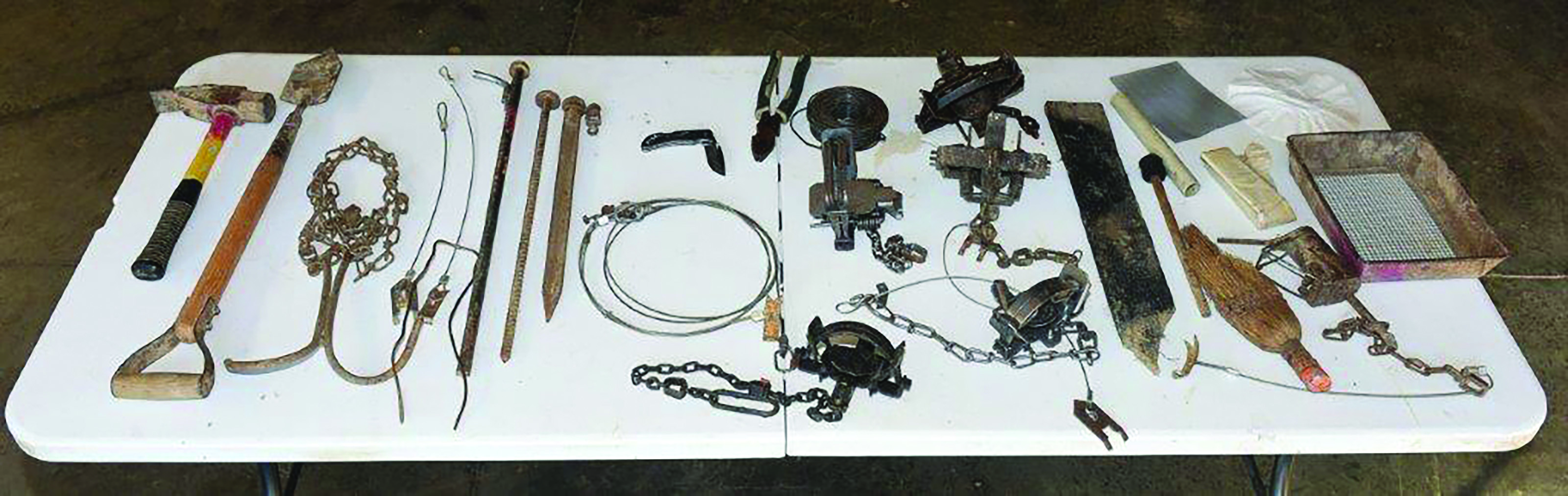
Equipment for Land Trapping
Land trapping has its own equipment needs.
- Packbasket. Use a packbasket to carry your equipment. If you don’t have a packbasket, use a backpack or a bucket. Remember to keep these containers free of any foreign odor that could get on your traps or other equipment.
- Dirt sifter. A dirt sifter allows you to cover traps and bait with fine soil. The sifter removes rocks or clumps that could keep the trap from closing properly.
- Sifters can be purchased at most trapping suppliers.
- To make your own, use ½" or ¾" lumber and a piece of ¼" hardware cloth. With the lumber, build a small open box 3" to 4" deep, 10" long, and 6" wide. Staple the hardware cloth onto the bottom of the box.
- Trowels. Use a trowel to dig trap beds. You can buy a trowel at a trapping supplier or from a garden store. It is a good idea to have both a 12"and an 18" trowel.
- Hatchet. Use a hatchet to drive stakes.
- Stakes and earth anchors. Stakes can be made from 1" angle iron or pieces of ⅜" to ½" steel rod. The stakes should be at least 12" long and sharp on one end. If you use a steel rod, weld a triangular piece of metal onto the end for a driving point. Drill a ⅜" hole at the top of each stake. The trap chain can be fastened to the stake with a nut, bolt, and lock washer with an S-hook. Earth anchors are best for land trapping.
- Trap pan covers. Covers are used to prevent dirt from getting under the trap pan, making the trap inoperative.
- Use a trapper’s cap or underalls to prevent dirt from getting under the pan. A trapper’s cap fits over the trap pan while the trap is being bedded. Underalls (made of foam rubber or fiberglass) sit under the trap pan to keep dirt out.
- To make an inexpensive pan cover, use wax paper precut to the right size. Crumple and unfold the wax paper before placing it on the trap. This softens the paper so that it will not make noise when an animal steps on it.
- Covers also can be made from screen, plastic, or pieces of clean cloth.
- Gloves. Wear gloves to keep human odors from contaminating your traps or other equipment. Good trapping gloves can be purchased at trapping supply stores or from stores that sell work clothes.
- Kneeling pad. A kneeling pad also helps keep human odor from contaminating your sets. Kneel on the pad while making the set. Kneeling pads may be cloth, canvas, or rubber.
- Catchpole (release noose). Use a catchpole to hold trapped animals as you release the trap. Target animals will need to be dispatched, and non-target animals can be released safely using your catchpole.
- Clothing. Follow these guidelines for clothing.
- Use footwear that can be washed off occasionally, such as rubber boots. Choose soles that won’t slip easily on snow, ice, or rough ground.
- Be prepared for cold weather. Wear a warm hat. Dress in layers so you can remove clothing if the weather warms up.
- Keep your clothes clean and odor-free.
- Choose clothing that does not make noise when you walk.
- Make sure you are visible to any hunters who might be in the area. Hunter orange is a good choice during certain hunting seasons.
- Carry lightweight raingear in case of rain.
- Other accessories. Always have your hunting license and trapping permit properly displayed in a weatherproof holder. Always carry a flashlight, waterproof matches, fire starters, a map, a compass, and a cell phone. A knife, wire, and pliers will come in handy. If you use snares, you’ll also need cable cutters.