Ringtail
- The ringtail is a member of the Procyonidae (raccoon) family and about the size of a ferret. It is shaped somewhat like a marten with an elongated body and tail of approximately equal length.
- It is named for its tail, which has has eight dark bands alternating with seven buffy bands. The upper body is long, pale brown with a lighter underbelly. They have large black eyes, surrounded by white rings of fur, tall oval-like ears, set wide apart, and short legs with semi-retractable claws.
- They are a solitary species, meeting only for the purpose of reproduction; and they’re excellent climbers capable of ascending vertical walls, trees, rocky cliffs, and even cacti.
- They are nocturnal, but they may be active in daylight hours during the reproduction season.
- They are broadly distributed throughout the U.S. and Mexico. They can be found from southwestern Oregon and eastern Kansas, south through California, southern Nevada, Utah, Colorado, Arizona, Oklahoma, Texas, Baja California, and Mexico. According to the Oregon Department of Fish and Wildlife, the ringtail occurs in Oregon in Lane, Douglas, Klamath, Jackson, Josephine, and Curry counties and is an Oregon Conservation Strategy Species in the Coast Range, Klamath Mountains and West Cascades ecoregions.
- The ringtail is legally trapped for fur in Arizona, New Mexico, Nevada, Texas, and Utah. Although some states have banned the hunting of ringtails, they still fall victim to traps set for other species. Also, their secretive tendencies can make it difficult for officials to track their population, so there is no hard estimate of population trends. However, they’re always found in small densities and aren’t considered abundant. A rough estimate of the population is 10.5 to 20.5 individuals/km².
- Threats to the ringtail include road and railroad construction, hunting and trapping, automobile impacts, habitat loss, and fragmentation.
Ringtail Facts
- Breeding period: February to early June.
- Birth period: April to July.
- Size: 12 to 16.5 inches in length with a body weight of 1.8 to 2.9 pounds.
- Number of young: 3 to 4 per litter.
- Gestation period: 51 to 54 days.
- Feeding time: usually nocturnal.
- Life expectancy: Average lifespan of 7 years in the wild and 14.3 years in captivity.
- Typical foods: Largely carnivorous with a diet consisting of mainly small mammals, such as rabbits, mice, rats and ground squirrels; however, their varied diet also includes birds, reptiles, insects, carrion, nuts, fish, and fruit.
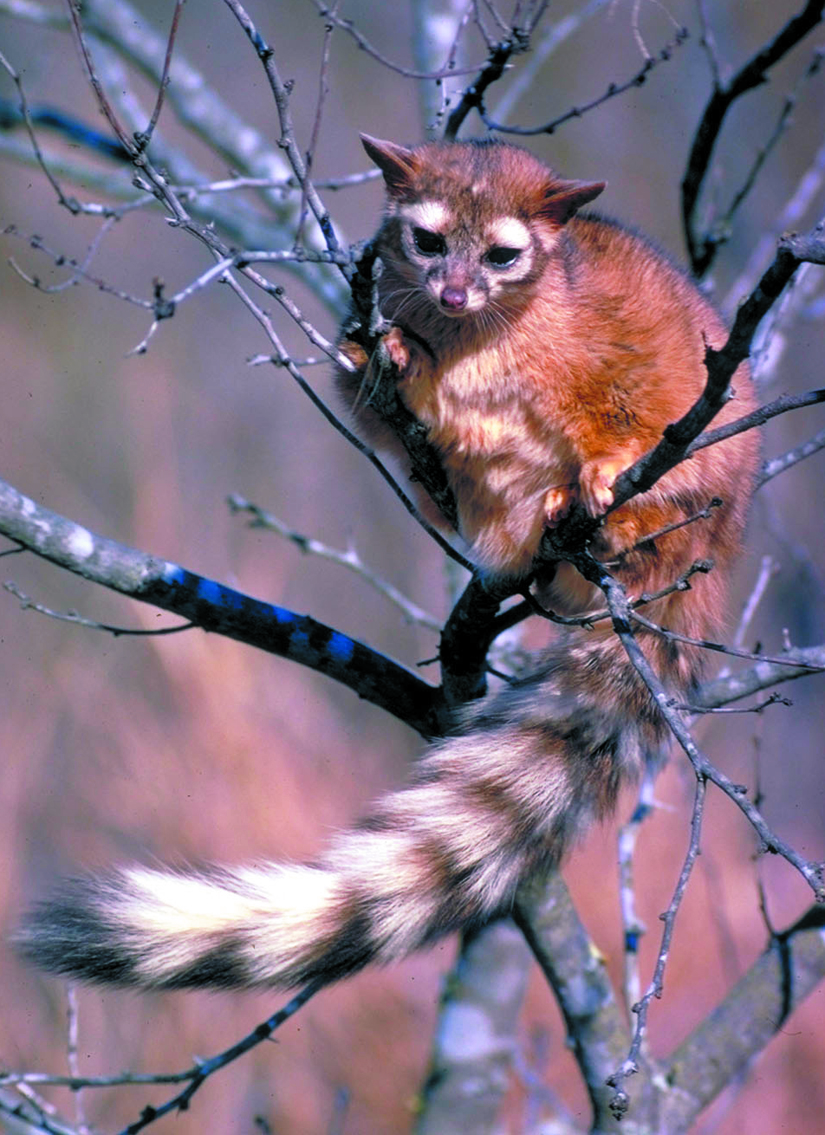
Ringtail